When your role stops needing you
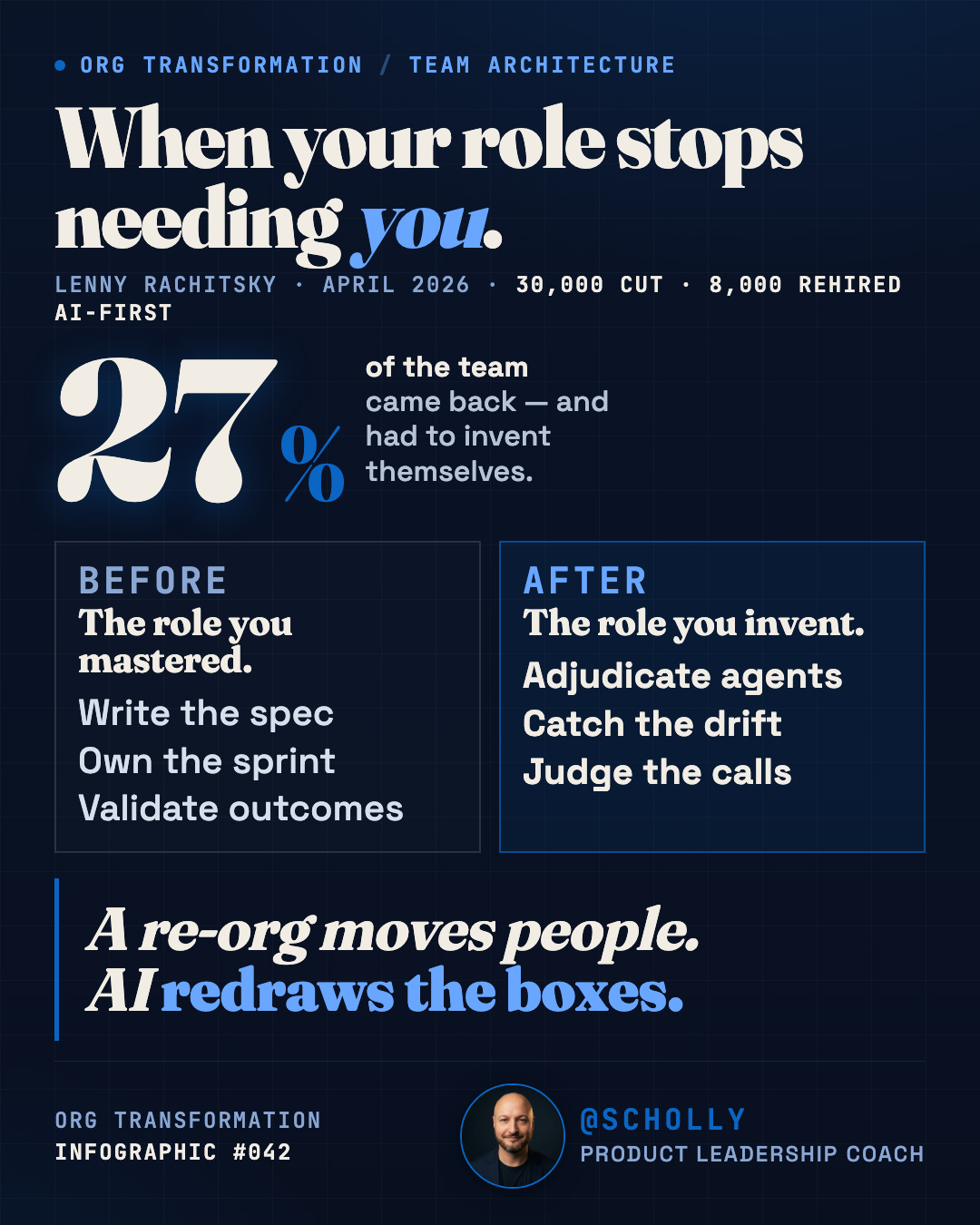
Lenny Rachitsky cut 30,000 jobs and rehired 8,000 AI-first. What broke isn't the economics — it's the identity of your senior PMs.

Two posts dropped from the same author in the same week in April 2026.
The first: a LinkedIn post about a tech company that cut 30,000 jobs and rehired 8,000 — this time structured around AI-first workflows. Viral. Sobering. The kind of post senior leaders forwarded quietly to each other.
The second: a Substack essay titled “The Visual Guide to Getting Out of a Creative Slump.” Same author, Lenny Rachitsky. Same week. About feeling stuck. About watching his own craft change underneath him.
That pairing isn’t a coincidence. It’s a signal most executives are still missing.
## The structural shift you already know
The first story is everywhere now. AI transforms workflows. PM roles consolidate. Middle layers compress. Senior ICs who understood tools like Jira, Productboard, and Amplitude suddenly share scope with agents that read 800 customer tickets in thirty seconds and draft a roadmap proposal with citations.
The economics are obvious. If you can rebuild a team at 27% of headcount and deliver more, you rebuild the team.
That part is a spreadsheet problem.
## The emotional layer nobody is coaching through
The second story is the one getting missed. When the role that made you redundant is the role that made you *you*, the transition isn’t a career event. It’s an identity rupture.
I’ve watched senior product leaders navigate this in the past six months. The pattern is consistent:
— Week 1: relief that their job survived the restructure
— Week 3: confusion about what their new scope actually means
— Week 6: a quiet grief for the craft they spent a career mastering
— Week 10: either resignation, rebuild, or resentment — no fourth option
Adam Grant, writing alongside David Beckham on LinkedIn last week, called resilience “reps, not personality.” He’s right. But you only get reps when you’re still willing to get on the field. Identity grief pulls people off the field.
## Why Team Architecture makes this predictable
In my Team Architecture framework — one of six frameworks I use with leadership clients — high-performing teams aren’t found. They’re deliberately built. And the reverse is true: when a team’s architecture shifts underneath them, the humans inside the architecture need to be rebuilt too. Roles don’t transfer automatically to new blueprints.
The mistake most VPs make right now is treating this like a re-org. It isn’t. A re-org shuffles people across boxes. An AI transformation redraws the boxes themselves.
Here’s what changes:
**Before:** the PM role was a translation layer. Business intent → spec → engineering sprint → validated outcome. The PM’s identity came from owning that translation.
**After:** the translation layer is distributed. An agent writes the spec. Another drafts the sprint plan. A third tests variants against customer signal. The PM’s new job — the one that survives — is adjudicating between agents, catching drift, and making the judgment calls the models can’t make.
Different job. Same title. Most leaders communicate the title transition and assume the identity transition handles itself.
It doesn’t.
## Coaching Distance is the only angle that works here
The Coaching Distance Principle — another of my frameworks — says the closer a coach works to the teams doing the actual work, the higher the success rate of any transformation. That’s especially true for identity transitions.
A VP who communicates this shift in an all-hands deck will lose the room. The language sounds like a consultant’s slideshow. The affected PMs hear “you don’t matter anymore” even when the words are neutral.
The language that works is specific, situational, and delivered at the seat of the work: “When you own Feature X, here’s what stays yours. Here’s what moves to the agent. Here’s what becomes new — and here’s where I need you to invent the job as you go.”
That conversation happens one desk at a time. Not in a memo. Not in a town hall.
Distant strategy fails this transition every time.
## The StepStone lesson I keep coming back to
In 2015 I walked into StepStone with a mandate to build the German product organization. The starting state was administrative. PMs took orders from Sales. There was no ownership. Roadmaps drifted across the Brussels-Düsseldorf axis like static.
I rebuilt the team — roles, reporting lines, hiring profiles, relationship to engineering, relationship to customers. Forty-plus people.
Two years in, some of the roles I had designed needed to die. Not because anyone failed. Because the business needed something different. I had to look at people I had hired personally, who had built the exact muscle I asked them to build, and redefine their jobs.
That is when I learned: the architecture work is twenty percent of it. The identity work — the conversations where you help a talented person map their skills to a shape that didn’t exist when they were hired — that is the other eighty percent.
AI transformation is the same pattern, compressed into months instead of years.
## The diagnostic senior leaders should be running right now
If you run a product or tech organization, one question is worth asking every senior IC on your team this month:
**”If your current role disappeared in six months and you had to invent the next one — what would you build?”**
The people who answer with confidence are the ones who will still be there eighteen months from now. The people who freeze, give vague answers, or get defensive are the ones silently grieving a role that hasn’t even ended yet.
You don’t fire the freezers. You coach them — at the seat of the work, one conversation at a time.
That is the whole job right now.
## What I am watching
Three signals I am tracking for the next 90 days:
1. How many product leaders publicly frame this transition as identity work versus role redesign.
2. Whether the companies cutting 30,000 to rehire 8,000 also invest in coaching the 8,000.
3. Which senior PMs are building their own next role instead of waiting for it to arrive.
Two of those three are coaching problems.
One is an architecture problem.
Your job as a leader right now is telling them apart.
---
*Torsten Schollmayer is a Product Leadership Coach based in Meerbusch, Germany. He helps VPs and CTOs through org transformations where the architecture and the humans have to rebuild at the same time. Find him as Scholly on LinkedIn.*